
Publish date: 13 April 2026
We have launched a new research study that could help detect lung cancer earlier using a simple breath test.
The VICTORY2 study will explore how analysing chemicals in a patient’s breath could help identify lung cancer and other lung conditions more quickly, potentially improving diagnosis and treatment for patients.
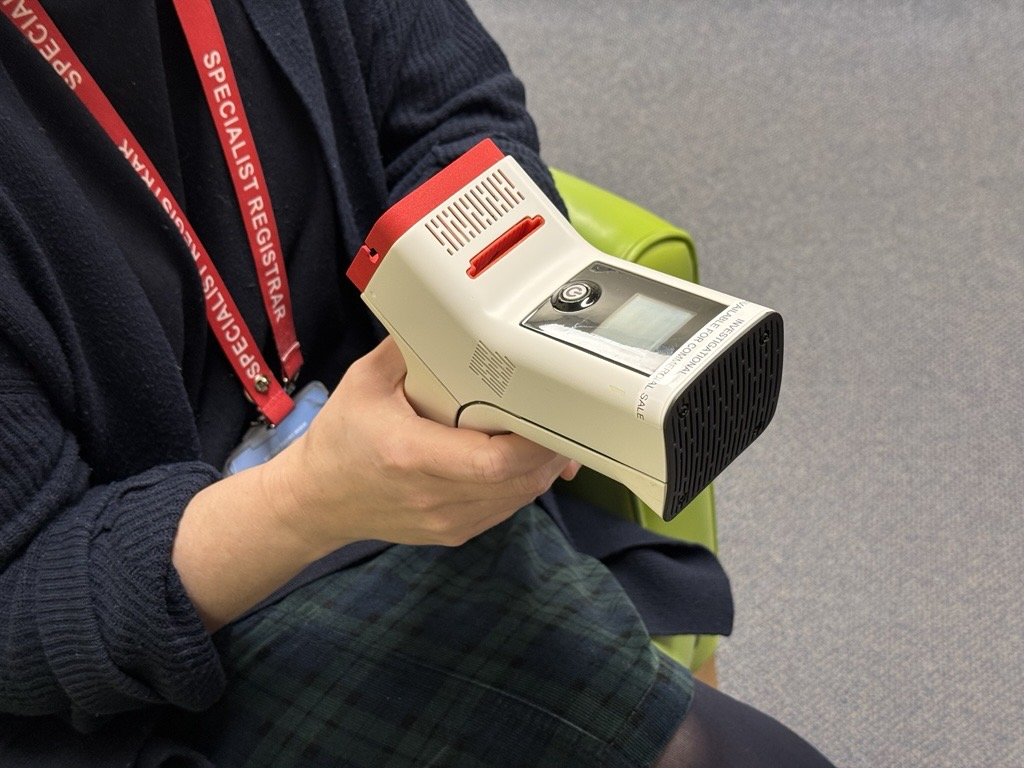
Researchers will use a device called Inflammacheck, which measures a range of markers in the breath – including hydrogen peroxide, carbon dioxide patterns, temperature, and humidity. These measurements create a unique “breath print” that can help clinicians distinguish between different lung diseases.
The study builds on earlier research known as VICTORY, which showed promising results in identifying conditions such as pneumonia and lung cancer using breath analysis.
Researchers will now expand the dataset and use advanced machine learning techniques to refine the technology and improve its accuracy.
Dr Laura Wiffen, Respiratory Research Fellow and one of the Principal Investigators at Portsmouth Hospitals University NHS Trust, said: “The idea behind this study is that different lung conditions leave distinct signatures in the breath. By analysing those markers, we can build a breath ‘fingerprint’ that helps us identify what might be happening in the lungs.
“If successful, this technology could help us detect lung cancer much earlier and support faster diagnosis for patients.”
Patients taking part in the study will be asked to breathe normally into the handheld device for just a few minutes during a clinic appointment. The test is non-invasive and requires only one sample.
Researchers will recruit patients who are undergoing investigations for possible lung cancer, alongside people with other lung conditions such as pneumonia, as well as a small number of healthy volunteers.
The results from the breath test will then be compared with patients’ final diagnoses to help researchers refine the technology and improve its ability to identify disease.
Lung cancer is often diagnosed at a later stage because early symptoms, such as a persistent cough or breathlessness, can be mistaken for other conditions. Earlier diagnosis can make a significant difference to treatment options and outcomes.
Professor Anoop J Chauhan MBE, Chief Research Officer, and Chief Investigator added: “Many people are diagnosed with lung cancer at a point where treatment options can be limited. Our aim is to develop a simple test that could help identify patients earlier and guide them more quickly onto the right diagnostic pathway.”
The study is funded through the National Institute for Health and Care Research (NIHR) and will run at Portsmouth Hospitals University NHS Trust alongside partner sites in Manchester and Stoke.
If successful, researchers hope the technology could one day be used more widely in settings such as GP surgeries or community clinics to support faster diagnosis of lung disease.