
Publish date: 16 June 2026
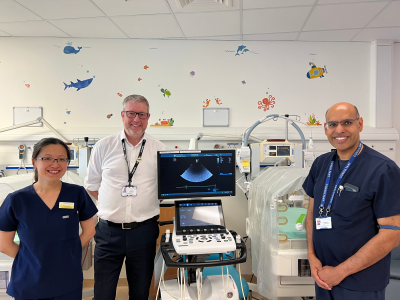
Developed in partnership between Portsmouth Hospitals University NHS Trust (PHU) and international medical imaging IT and cybersecurity company Sectra, the new approach means that scans previously stored on hard drives on ward-based scanners, can now be made immediately available to specialists in any location, who can then deliver urgently needed advice.
Clinical teams in Portsmouth’s Neonatal Intensive Care Unit (NICU) at Queen Alexandra Hospital can now seek urgent specialist opinion from consultants in hospitals across the region quicker, thanks to the ability to share point of care ultrasound scans in real-time, for the first time.
Dr Hushi Hu, a neonatal consultant at PHU, said: “For time-critical reviews, being able to share point of care ultrasound scans easily with clinical specialists in real-time has already proven very important. Babies born with congenital heart defects, or brain related diagnoses such as post-haemorrhagic hydrocephalus, as well as other serious conditions, require close monitoring and possible surgical interventions.
“Babies will have regular scans of their heads and hearts during their time with us. We can now more easily remain in informed dialogue with other specialist teams, who can see those images in real-time as they assist in reviewing and providing timely opinions, on whether we need to move a baby to a different site, and on the right course of action.”
Unlike ultrasound scans carried out by sonographers and imaging departments, diagnostic images captured by our Neonatal Intensive Care Unit are not managed through radiology IT systems that assign images to records. Previously, staff in different departments, would have needed to communicate and complete a series of manual processes to transfer images from scanning devices in NICU, using USB sticks and CDs to upload them to patient records.
But this new process means that our NICU team just enter a patient name and hospital number on their ultrasound machine, which triggers an automatic process, so the image becomes part of the correct baby’s record. Images are then made available to staff through the Trust’s electronic patient record and its imaging solution from Sectra – a shared system used by healthcare professionals across five NHS trusts in the region. Processes have also been created so that images can be assigned for babies yet to be named.
The new process is delivering significant benefits across hospitals in the region that are part of an NHS imaging network called SWASH+, and several trusts have already shown interest in the work and are starting to adopt similar approaches.
Within the Trust, further benefits are expected to expand as more point of care scanners in the Acute Medical Unit, Emergency Department and Intensive Care Unit come on board.
Dr Ramkrishna Ramnauth, a consultant in acute medicine at PHU, said: “Point of care ultrasound governance is a huge issue that kept me awake at night, so I’m glad we have now manged to solve this problem. I use point of care ultrasound at least twice during my ward rounds – especially with people who are acutely short of breath. It can tell you if someone has fluid overload, early pneumonia, pleural effusion, and much more. It can help to reduce harm, reduce pressure on radiology, and inform when to refer patients to ICU.
“We’ve trained a huge number of people in this skill, providing vital knowledge in clinical practice: but if imaging disappears once hard drives are full, that creates unnecessary risk. We need to be able to look at a patients’ journey and examine why decisions were made. The ability to store and withdraw images will have a huge impact, contributing to a complete history of patient care.”
Mark Gardner, head of radiology IT and digital imaging architect for PHU, said: “Overcoming this significant technical burden has been a process, but our partnership with Sectra has made it possible. The term ‘enterprise imaging’ is often used in healthcare diagnostics, but together we are re-defining what that means by making encounter-based imaging part of our patient’s record.”
Jane Rendall, UK and Ireland managing director for Sectra, added: “Portsmouth’s Neonatal Intensive Care Unit’s drive to secure and improve access to imaging for premature and poorly babies, has started an important drive to break down a diagnostic imaging silo that until now has remained a challenge for many healthcare providers.
“The Trust is a longstanding partner with Sectra and I’m excited to see this latest achievement in our work together continue to expand. Importantly, this isn’t about replacing radiology information systems, rather it is about creating ways to efficiently and accurately bring imaging not generated by radiology, into places where it can be best used for patient benefit.”